Love Gratitude Joy
/
This post may contain affiliate links. It is for informational purposes only and not medical or nutritional advice. [See our disclosure]

Why We Chose to Focus on Recovery
This is Scott’s Healing Journey — Part 11, the point where survival stopped being something we reacted to and became something we had to consciously sustain. The immediate crisis had passed, but what came next required a different kind of strength — one rooted in recovery, focus, and mental endurance.
By the time the immediate crisis stabilized, something else became clear:
Survival wasn’t just physical.
It was mental.
Up to that point, everything had been reactive — labs, appointments, waiting, fear. We were doing what needed to be done to get through each day.
But as the days turned into weeks, we realized that how we thought — where we put our attention — was going to determine whether we could sustain the work healing required.
Table of Contents
Where We Put Our Focus
One of the quietest but most important decisions we made during this time was about where we put our attention.
There was no shortage of information about worst-case scenarios.
Every search led to progression.
Every statistic circled back to decline.
Every forum seemed to end in death.
We learned quickly that living there — mentally — was exhausting us.
So we made a conscious choice.
We focused on recovery.
Not because we were naïve.
Not because we ignored reality.
But because fear wasn’t helping us heal.
That didn’t mean we pretended the risks didn’t exist.
It meant we stopped rehearsing outcomes we couldn’t control.
We believed the body is responsive.
We believed consistency mattered.
And we believed that what we consumed mentally influenced how well we could show up day after day.
That belief wasn’t abstract.
It was practical.
We couldn’t afford to live in fear and still do the daily work healing required.
When the Picture Became Overwhelming
As Scott’s lab results kept shifting, they began raising the possibility of multiple autoimmune conditions.
What we didn’t yet understand was that severe metabolic dysfunction can mimic autoimmune disease — creating inflammatory patterns in bloodwork that point in multiple directions at once.
What followed was a spiral I wasn’t prepared for.
Every diagnosis led to another.
Every possibility came with a different treatment plan.
And nearly all of them involved multiple medications, layered on top of one another — each with its own list of potential side effects.
What terrified us wasn’t just the diagnoses themselves.
It was the loss of clarity.
How would we know what was helping?
What was harming?
What was a side effect versus disease progression?
Scott’s body was already overwhelmed. The idea of adding layers of medication — without a clear baseline — scared us deeply.
So we made another deliberate decision.
Before adding complexity, we wanted to give his body the cleanest, most supportive environment possible — to see what it could do when it wasn’t being pulled in multiple directions at once.
This wasn’t about rejecting medical care.
It was about sequencing.
The Confirmation That Changed Everything
When we finally reached the second specialist, much of what we had already suspected was confirmed.
Scott was dealing with metabolic syndrome.
Hearing that wasn’t shocking — it was validating.
The labs.
The liver stress.
The insulin resistance patterns.
The systemic nature of what was happening.
It finally had a name.
And that mattered — because it meant the changes we had already begun making weren’t random. They were addressing an underlying metabolic issue, not just chasing lab numbers.
What We Learned — And What We Couldn’t Find
Like many people, we had been learning from voices like Dr. Ken Berry, Dr. Annette Bosworth, and Dr. Anthony Chaffee.
They spoke clearly about the benefits of low-carb, keto, and carnivore approaches for:
- inflammation
- fatty liver
- and many chronic conditions
But there was one thing we couldn’t find.
No one was talking about a case like Scott’s.
We could find examples of improvement in early-stage disease.
We could find metabolic reversals.
But we could not find clear examples of someone being transplant-listed with cirrhosis recovering the way Scott needed to.
That absence mattered — because we weren’t looking for theory. We were looking for proof that staying the course made sense.
That uncertainty stayed with us.
We kept asking ourselves:
Is this the one condition where improvement really is impossible — like the first doctor said?
We weren’t following a proven roadmap.
We were extrapolating — carefully — from what we did understand about physiology, insulin resistance, inflammation, and liver burden.
And we were doing it while scared.
What gave us the courage to continue wasn’t a promise of reversal.
It was this question:
Is this the best chance we can give his body?
Rock Bottom and the Truth About Change
There’s something else we learned about ourselves — and it wasn’t easy to admit.
Sometimes, it takes hitting rock bottom before we’re willing to make real change.
Before this, life was comfortable. Busy. Familiar.
It was easy to reach for convenience.
Easy to grab fast food.
Easy to sit on the couch instead of moving.
Nothing felt urgent enough to demand a full reset.
If it hadn’t been this bad — if it hadn’t been life and death — I don’t know that we would have gone all in the way we did.
That’s not shame.
That’s honesty.
Without this crisis, I don’t think we would have changed the way we did. The path we were on might have led to quieter consequences down the road — worsening metabolic health, cardiovascular disease, maybe even a sudden heart attack years later.
Urgency clarified what motivation alone never had.
When “Impossible” Became Fuel
I won’t pretend I wasn’t angry when the first doctor said improvement was impossible.
Those words were maddening in their certainty.
They felt final —
like the story had already been written without us.
And the truth is, that statement could have gone either way.
It could have crushed hope.
It could have led to resignation.
It could have made Scott stop fighting altogether.
In that sense, it felt dangerous.
Reckless.
But for Scott, it did the opposite.
Hearing “impossible” didn’t make him give up.
It pushed him to go all in —
not partially,
not temporarily,
not “we’ll see how this goes” —
but fully.
I don’t know if that outcome was intended.
And I don’t believe anger heals anything.
But sometimes certainty — even incomplete certainty — forces a decision.
And in our case, it forced clarity.
Why Sustainability Became Non-Negotiable
Once Scott made that decision, our role became clear.
If he was going to commit fully, we had to make sure that commitment was livable — not just survivable.
That’s where food stopped being a “diet” and became a strategy.
We didn’t want improvement followed by relapse.
We didn’t want temporary compliance followed by old habits the moment labs improved.
We wanted a new normal.
That’s where our recipes began.
Not as restriction.
Not as deprivation.
But as a way to make consistency possible.
Because healing only matters if you can stay there.
Why This Chapter Exists
This chapter isn’t about mindset as a cure.
It’s about protecting mental energy so the work can continue.
We’re sharing this because:
fear is exhausting
overwhelm is paralyzing
and healing requires presence
If you’re in this place now — scared, searching, trying to do everything right — know this:
Focusing on recovery is not denial.
Choosing not to live in worst-case scenarios is not ignorance.
Protecting your mental energy is part of staying engaged.
This was how we stayed intact long enough to do the work.
And it’s why everything that follows — the food, the routines, the recipes — was even possible.
Next: Part 12: Food, Comfort, and Consistency →
✨If you’re new here, you might also enjoy 💖 Our Story, The Joy List 🌟— Our Ultimate All Day Playlist — the Recipes we lean on when food becomes part of healing — and 🐶 Fur Baby Tales, where we share life through Jack’s eyes.
For readers unfamiliar with how liver severity is commonly assessed, the MELD score (Model for End-Stage Liver Disease) is one of the standard tools used by transplant teams to evaluate liver function over time. You can learn more about how it’s calculated here.
Meet Kristy, Scott & Fur Baby Jack

When Scott was diagnosed with end-stage liver failure, we turned to food, supplements, mindset - and hope. Together we transformed
our health, and our pup Jack has been on his own inspiring healing journey too. We share recipes, tips, and stories rooted in
love, gratitude, and joy.
Our Story
Recent Recipes
Recent Post
Scott’s Bloodwork Timeline
Scott’s Healing Journey — Part 14: What Comes After Recovery
Scott’s Healing Journey — Part 13: A Way of Life
Scott’s Healing Journey — Part 12: Food, Comfort, and Consistency
Scott’s Healing Journey — Part 11: Choosing Recovery
Scott’s Healing Journey — Part 10: Navigating the Medical System in Crisis

The Joy Is Contagious
Join the LGJ newsletter to get the latest recipes, tips and more! Only the Recipes We Love - Always Gluten-Free. Always Low-Carb.
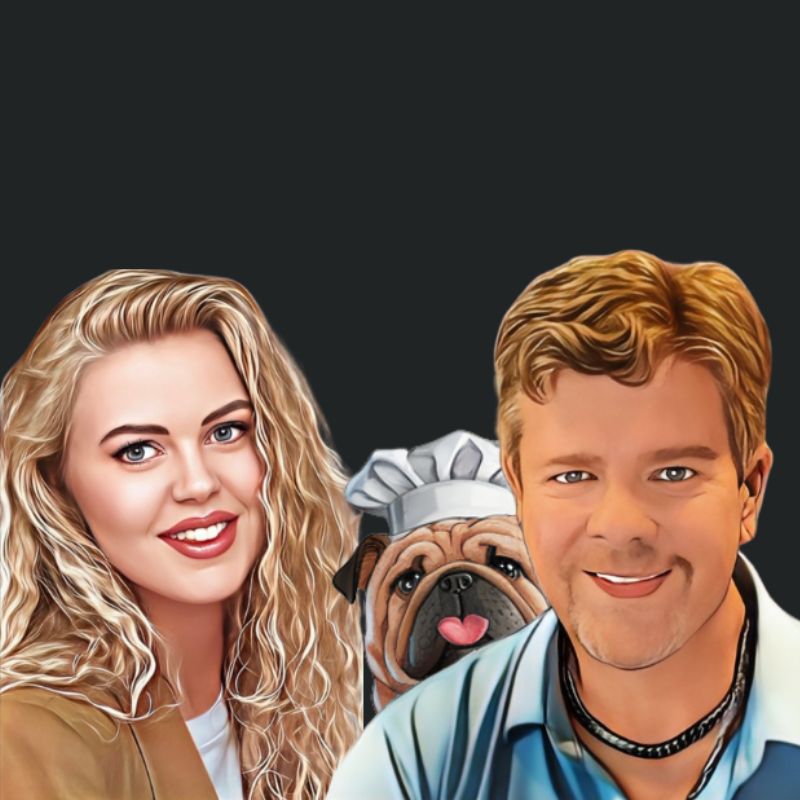
We’re Kristy and Scott — partners in life, healing, and all things delicious (and low carb). What began as a mission to save Scott’s liver health turned into an entirely new way of living: rooted in love, gratitude, and joy. Along the way, our four-legged sidekick Jack has been the heart and joy of the journey — taste-testing steak, keeping us grounded, and reminding us what really matters. This is our story, and we’re so glad you’re here to be part of it.