Love Gratitude Joy
/
This post may contain affiliate links. It is for informational purposes only and not medical or nutritional advice. [See our disclosure]

Scott’s Healing Journey: When Healing Was Said to Be Impossible
Scott’s Healing Journey — Part 2 marks the moment we were told healing was impossible without a transplant — and quietly began questioning everything we’d been told.
At first, we accepted the story we were given.
Not because it made sense —
but because we didn’t yet know how to do anything else.
We were both in shock. Trying to be brave. Sitting there, listening, nodding, absorbing words that felt heavy and unreal all at once. I remember watching Scott more than I remember hearing the details. He was calm. Too calm. And I was quiet in that way you get when your mind is racing but your body hasn’t caught up yet.
There was no sense that this was a conversation.
No curiosity.
No questions about how he had actually been feeling before that moment.
No eye contact.
Just a conclusion delivered bluntly, as if the story had already been written.
On the way to the car, we held hands — the way we always do — like everything was normal. Like muscle memory had taken over. We didn’t say much. A few practical words, maybe. Enough to function. Not enough to touch what we were both thinking.
The drive home is still vivid to me.
We talked about logistics — appointments, next steps, practical things. Normal things. But underneath it, my mind was screaming. Something didn’t fit. I couldn’t articulate it yet, but I could feel it in my body.
Scott wasn’t profoundly fatigued before that appointment.
He wasn’t bedridden.
He wasn’t collapsing.
Yes, there had been symptoms. Yes, something was clearly wrong. But he had been living his life. Working. Functioning. Present.
Everyone’s body tells its story differently. Some people feel the symptoms first. Others feel the weight of the story before the symptoms arrive. At the time, I didn’t have language for that — only the unsettling awareness that the timeline didn’t line up.
About a week later, everything changed.
That’s when the exhaustion came.
Heavy.
Sudden.
Relentless.
He started sleeping 18 to 20 hours a day. Watching it happen was terrifying. And the thought I couldn’t escape was this:
Did this start after we were told it would?
That night, I cried in the bath — under the water, so Scott wouldn’t hear.
Not quietly.
Not neatly.
But hidden.
My body needed the release. Crying was the only way it knew how.
I needed to be brave for him. I needed him to see no fear. Only certainty. Only belief that he would make it — no doubt, no hesitation.
Alone, everything came out.
I cried in disbelief and fear and wonder, all tangled together. Could this really be true? Could he die at any moment? Is this how it happens? I replayed the appointment over and over, searching for something I’d missed — some clue that would make it make sense.
Was it divine intervention? A Godwink that we got him in before the collapse? I still don’t know. I just know the order of events mattered, even if I didn’t yet understand why.
One thing was clear almost immediately: we wanted a second opinion.
And then there was the food advice.
The specialist told Scott to go home and eat peanut butter and jelly sandwiches. That his liver needed glucose. That sugar would help.
I remember standing there, nodding — and knowing, deep inside, that it felt wrong.
I had already been studying his bloodwork. I had already seen signs of a system under serious stress. And everything I was reading was pointing in the opposite direction — that sugar and refined carbs weren’t helping his body. They were adding to the strain.
At the time, I didn’t argue. I didn’t push back. I didn’t say any of it out loud.
But I couldn’t unsee what I was already seeing in his labs. And I couldn’t shake the feeling that following that advice blindly might do more harm than good.
That moment stayed with me.
Scott was scared — I think anyone hearing that would be. But he was brave. He never showed it. Or maybe he simply refused to believe it.
His body was craving sugar, the way a body in metabolic dysfunction does. And the doctor had said this was what he should eat.
If I pushed too hard, too fast, I knew what might happen.
He might decide, If I’m dying anyway, I’m going to eat what I want.
So I didn’t push.
I eased.
I knew I had to make this feel like his idea — or at least his choice. And I knew him well enough to know one more thing:
He’d want to see.
We’re competitive like that.
So I started testing my own glucose and ketones. Not as a challenge — just enough for him to notice.
I didn’t explain it.
I didn’t persuade.
I let the numbers sit there.
I let curiosity do what fear couldn’t.
It took a week and a half. Maybe two.
Then one day he said,
“Let me see what mine are.”
That moment mattered more than either of us realized.
Table of Contents
Scott’s Healing Journey: When the Body Began to Decline
But before things turned around, they got darker.
Within days of his decline, there was one person I had to tell — a gentleman we do business with who had spoken to us almost weekly. At that point, and for an unknown stretch of time, it would likely only be me on those calls.
Scott could no longer communicate the way he had been. He was sleeping constantly — 18 to 20 hours a day — barely present.
To this day, he doesn’t remember much from that time.
I went into my closet so Scott wouldn’t hear me.
I thought I could be brave. I thought I could just say the words. But when I tried to explain that Scott might be dying — that for a while communication would have to go only through me — my voice broke. I started crying mid-sentence, struggling to get the words out.
I didn’t want Scott to hear that fear spoken out loud.
This gentleman was calm. Brave. He simply believed Scott would recover. He never made it a thing. He didn’t press or ask for updates. He just assumed Scott would be back on the calls when he was ready — and until then, he let it be.
And him letting it be helped me believe.
We didn’t want to tell anyone — not even our families. We told only two people. We didn’t want the energy of fear or death hovering over him.
A few weeks later, when things were still getting worse, I had to tell my mom. She was only the second person we told.
Not with updates.
Not with details.
Just enough so that if we ended up in the hospital, she would know she might need to come get Jack.
She was brave. And wonderful.
I didn’t want to keep updating people. There was no progress to report. Only uncertainty. Only the question that haunted me daily:
Is this healing… or is this how dying looks?
The doctor put him on a diuretic for severe ascites.
Scott lost over 40 pounds in a matter of weeks — much of it fluid. He had become thin and frail.
He was uncomfortable all the time. Sleeping used to be his favorite place. He loved our bed. Suddenly, nothing felt right. Even our once-comfortable bed — the place he loved most — felt like sleeping on rocks. No position brought relief.
I ordered a new king bed.
A new mattress.
Extra-fluffy pads.
Pillows. Nice sheets.
Anything that might bring relief.
All I knew was this: if this was the end, I was going to make him as comfortable as possible. I was going to be brave for him.
Scott is a truly good, kind, loving, generous, funny, thoughtful soul — my best friend, the love of my life. I was going to be there, creating comfort where I could: moments of normalcy, even joy and laughter, while quietly researching and trying to put healing foods in front of him.
When he started collapsing in the wee hours of the morning, trying to get to the bathroom — blacking out and going down without warning — I was terrified he would hit his head. I bought him an Apple Watch so it would alert me if I didn’t hear him fall.
I needed to know if he went down when I wasn’t right there.
We spoke to the doctor. He said it could be a few things — blood pressure dropping when he stood up too fast, or blood sugar swings — but there wasn’t really anything to do about it.
No clear cause.
No real treatment.
Just something to watch.
Separately, his bloodwork showed his blood wasn’t clotting properly. That part did fit the labs — the numbers around clotting and red blood cells were clearly out of range.
He bruised badly from the slightest touch. Even his watch would leave marks.
He also had brutal, relentless itching — especially on his arms and across his back — and it was always worse at night, when he was finally still. We used an anti-itch spray just to get him through bedtime. Later, we added ox bile to help get bile salts moving, hoping it might ease what his body was clearly struggling to process.
What didn’t fit was the conclusion — that there was nothing to be done.
I started researching. Constantly. Relentlessly.
I came across information about spirulina and chlorella and their role in supporting blood health and clotting. Scott didn’t want to add another pill. He was already taking so many. He asked the liver specialist what he thought.
The doctor said he didn’t think it would help — but he didn’t think it would hurt either.
Scott agreed to try it.
And what happened next was not subtle.
The bruising — which had been alarming and constant — began to change. Marks that had appeared from the slightest touch stopped showing up. His skin no longer looked fragile. The fear around his red blood cells and clotting eased as his blood tests began to improve.
It was dramatic.
It was visible.
And it mattered.
We didn’t have answers yet.
We didn’t have a plan.
But we had a question.
Could proper nutrition and targeted supplements help him heal and possibly avoid a transplant? Were we being naïve? Too hopeful?
This wasn’t the turning point. Not yet.
But it was the moment we stopped blindly accepting the story — and started listening instead to what his body was actually saying.
We weren’t trying to be optimistic.
We were trying to be honest about what we were seeing.
Through all of it, one thing kept surfacing:
The story we were told didn’t fully account for what we were living.
And that realization — subtle but undeniable — was the first crack in the certainty we’d been handed.
We’re sharing these private details for one simple reason. If someone is in this place right now, we want them to know how bad it was — and that he did recover.
There is no one-size-fits-all path. No guarantees.
But even where we were — even when it looked like this — healing was still possible.
Continue the story in Part 3 → Initial Encouragement
You can view Scott’s full bloodwork progression and MELD score changes here → Scott’s Bloodwork Timeline
✨If you’re new here, you might also enjoy 💖 Our Story, The Joy List 🌟— Our Ultimate All Day Playlist — the Recipes we lean on when food becomes part of healing — and 🐶 Fur Baby Tales, where we share life through Jack’s eyes.
Meet Kristy, Scott & Fur Baby Jack

When Scott was diagnosed with end-stage liver failure, we turned to food, supplements, mindset - and hope. Together we transformed
our health, and our pup Jack has been on his own inspiring healing journey too. We share recipes, tips, and stories rooted in
love, gratitude, and joy.
Our Story
Recent Recipes
Recent Post
Scott’s Bloodwork Timeline
Scott’s Healing Journey — Part 14: What Comes After Recovery
Scott’s Healing Journey — Part 13: A Way of Life
Scott’s Healing Journey — Part 12: Food, Comfort, and Consistency
Scott’s Healing Journey — Part 11: Choosing Recovery
Scott’s Healing Journey — Part 10: Navigating the Medical System in Crisis

The Joy Is Contagious
Join the LGJ newsletter to get the latest recipes, tips and more! Only the Recipes We Love - Always Gluten-Free. Always Low-Carb.
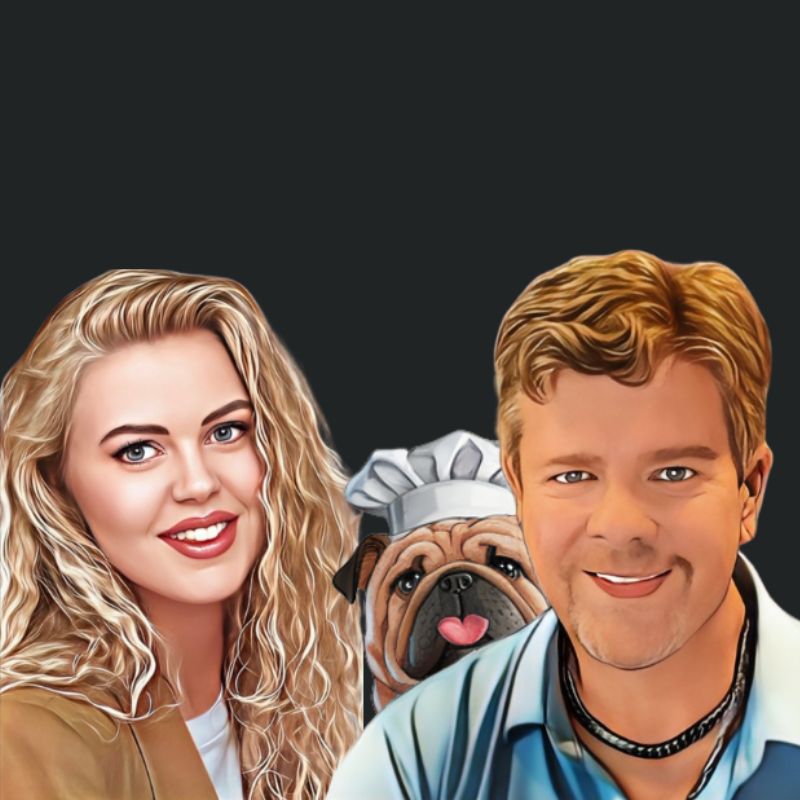
We’re Kristy and Scott — partners in life, healing, and all things delicious (and low carb). What began as a mission to save Scott’s liver health turned into an entirely new way of living: rooted in love, gratitude, and joy. Along the way, our four-legged sidekick Jack has been the heart and joy of the journey — taste-testing steak, keeping us grounded, and reminding us what really matters. This is our story, and we’re so glad you’re here to be part of it.